The Free Banana Problem
Why losing all our jobs to AI could be a good thing, and what has to go right during the transition.
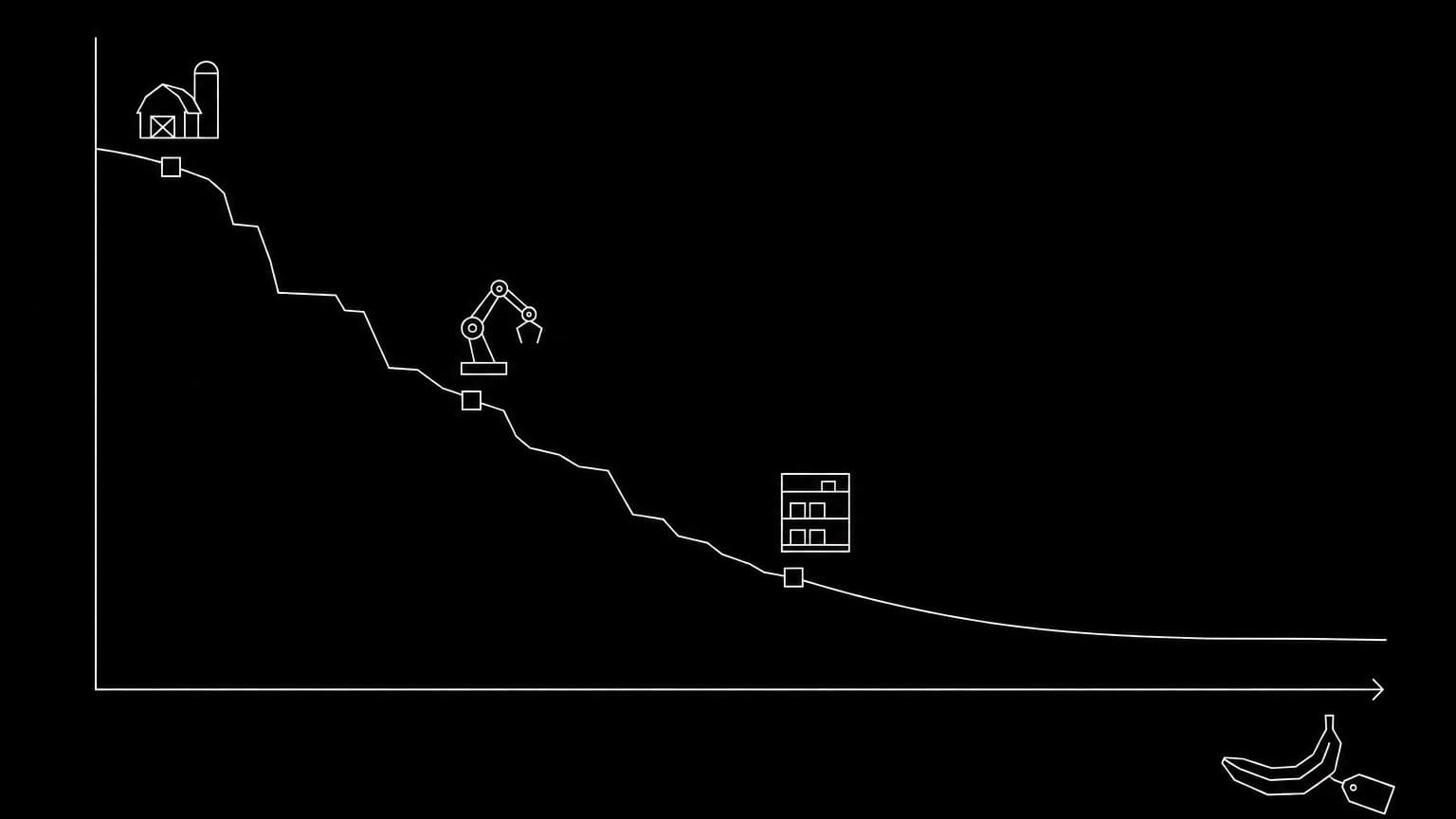
We are going to lose all of our jobs and that’s a good thing. AI promises abundance for all things knowledge, and knowledge is upstream of what makes our economy function. Some might read this and think but how am I going to survive? Will my kids be okay? All this is natural to what we are used to. But a few assumptions have to be looked at before a question like that even makes sense. Ever since trade was made a thing we have always traded things and captured some value on that trade to make a living. And for labor to be traded for monetary gain that implies labor is a scarce resource to begin with.
Now what if labor wasn’t scarce to begin with? We can call our favourite AI to pick us up for lunch and drop us off at our home all for free. What I am insinuating is an abundance of all goods and services. You can go to the grocery store and get anything you need for free, how cool would that be? The reasoning is pretty simple, take for example I want a banana, I go to the store, it costs $0.646/lb. It costs that much mainly because of everything it took to bring it to where it is, all the middle layer from where it was grown to where it sits in the store, and maybe a few cents for maintenance on the farm it was grown on. You are paying for that middle layer, and the middle layer is mostly human labor. What if all of it was automated, farm to shelf? Then the labor cost disappears and what’s left is machines and energy. First we will price the banana on how much energy it takes to make it, then as energy gets cheap it converges toward the cost of the raw stuff itself, the land, the water, the fertilizer. Not literally $0 but close enough that it rounds to free for any one person.
Here’s the catch though, and honestly this is the part that took me the longest to see. Automation drops the cost, but it’s competition that drops the price. If like three companies own the entire automated supply chain, the banana costs whatever they say it costs and all the abundance just piles up as their profit. So the free banana future isn’t automatic, it needs either a ton of competition between automated producers or policy that forces the savings through to us. Whoever owns that middle layer during the transition is sitting on the most valuable thing in economic history, which is exactly why we can’t just assume this goes well on its own.
And that transition is the real answer to “will my kids be okay?” The scary part isn’t the destination, it’s the gap. Jobs disappear before prices collapse. Your wage can go to zero years before the banana does. This is where what Elon calls universal high income comes in, in contrast to universal basic income, regular payments large enough that there will be no poverty and people won’t need to save, work becomes optional, like a hobby. The way I think about it now, UHI isn’t the end state, it’s the bridge across that gap while prices are still falling. And the checks won’t cause runaway inflation for one specific reason, AI and robotics will be producing goods and services way faster than the money supply grows. Print money into a stagnant economy and you get disaster, print it into an economy where production is exploding and prices can still fall.
One thing abundance never fixes though, stuff that’s scarce by definition. There is one beachfront lot, one courtside seat, one top spot in the class. Bananas can become free, land in a good school district can’t. If inflation shows up anywhere in this future it shows up there, everyone bidding on the fixed stuff once the necessities are free.
It took me a while to actually wrap this in my head that this isn’t a socialist idea whatsoever. Socialism implies the means of production will be owned by the public, the workers, or the state, rather than by private individuals. This isn’t that. In the end state no one has to own anything because owning it wouldn’t benefit them anymore, same way nobody bothers to own the air. Nothing gets seized, you just need automation plus enough competition that the gains actually reach everyone.
One more thing to be honest about, the banana is actually the hard case not the easy one. AI is eating knowledge work first, farming and trucking and warehouse robots are lagging behind it, so the physical abundance shows up after the digital abundance, maybe well after. AI is moving exponentially and I am not going to give any timelines because I would just be guessing. This is one of the possible futures, not a guaranteed one, and it’s the one I am hoping for.